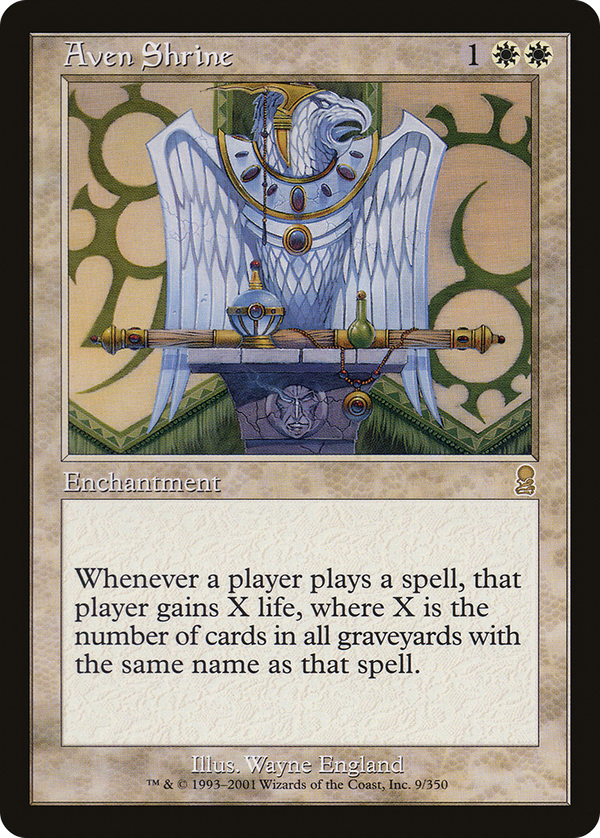
Aven Shrine


The trigger watches for a very specific texture: not how many spells get cast, but how many copies of one named spell are already sitting in graveyards when its twin goes on the stack. That makes the payoff scale with redundancy rather than volume, rewarding decks that lean on four-ofs and have already milled, discarded, or cast their duplicates. It fits naturally alongside an era of graveyard-matters design built around threshold and recursion, since the cards most likely to stack up by name (cheap, repeatable spells played over a long game) are exactly the ones that feed it. The symmetry is the wrinkle: it triggers on every player's casts, so an opponent running the same staples banks life off their own duplicates too, with no downside imposed on either side. In practice the effect is a slow trickle that rarely turns a game on its own. What the card documents is a design willingness, common in early-era enchantment design, to print value whose entire proposition depended on the grain of the graveyard, trusting players to notice that two copies of one spell were now worth more than one. The same-name clause is what dates it; counting graveyard duplicates by name stayed a niche idea, mostly tied to the block whose surrounding machinery made it legible.