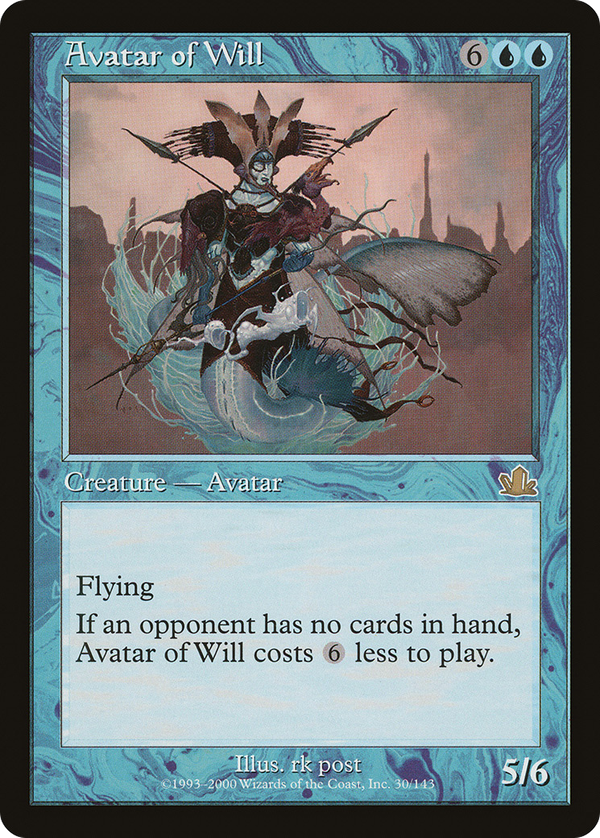
Avatar of Will


Eight mana for a 5/6 flyer is a non-starter; two mana for the same body is a bargain. The whole card lives in that gap, and the bridge between the two prices is whether your opponent's hand is empty. That single condition turns a fringe fatty into a payoff for an entire archetype: the discard-and-deny shells of the era, the ones built to strip a hand and keep it stripped. Empty the opponent's grip with Hymn to Tourach or a Megrim-style attrition plan, and the Avatar lands for two, sized to close the game before they rebuild. There is no middle rate here, which is the point: one card in hand and you pay full freight, so the body becomes a reward for completing the loop rather than a generic finisher you can jam on curve. That conditional cost-reduction template (a creature whose price collapses when a hand or battlefield state is met) is a design Wizards has returned to repeatedly, but here it is wired specifically to the hand-attrition plan, asking the deck to do the hard work first and offering the flyer as the spoils. It rewards a built-around strategy with a clean, evasive clock, which is exactly the kind of payoff a dedicated discard deck needs and exactly why it never escaped that lane.
Rules text
less to cast.
Flying