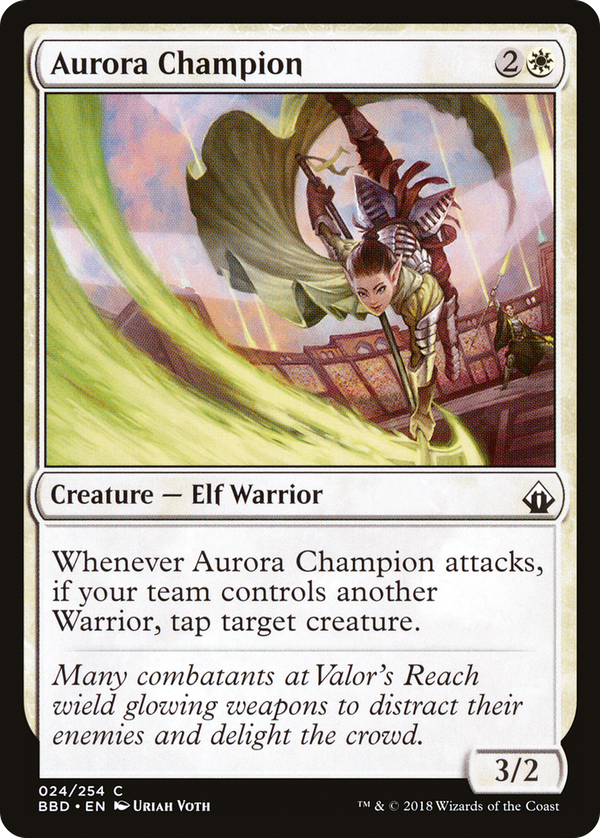
Aurora Champion


That "if your team controls another Warrior" condition points across the table rather than down at your own board, which is the design signature of a card written for shared combat. Most tribal payoffs check only what you control; here the Warrior that switches on the tap trigger can belong to a partner, so two players splitting Warrior duties both feed a single attacker's ability. The body doing the attacking never has to be the one supplying the type, and that separation widens the deckbuilding net considerably: your teammate's board can satisfy a condition your own board does not. The effect itself is a modest slice of attacking tempo. Because the trigger fires when this creature attacks (on your turn) the tapped creature untaps normally during its controller's next untap step, so this is not a freeze that pins down attackers; it clears a single blocker before damage and opens a lane for the swing. The interest is structural rather than a matter of raw rate. Read in isolation, it looks like ordinary tribal filler; it only resolves into something coherent once a partner's creatures count toward the trigger. The wording still functions when you field a second Warrior yourself, which keeps it from sitting dead, but the cooperative framing shapes everything about how the card is meant to be played.