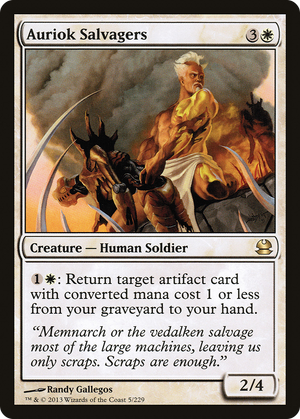
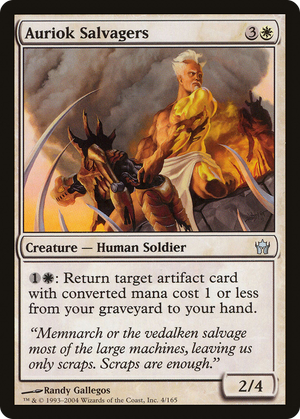
Auriok Salvagers


The recursion clause reads like a value engine for cheap-artifact environments, and for years that is mostly what it was: a slow loop returning the occasional Bonesplitter, a few mana per turn buying back something modest. The combo line is what rewrote the card. Pair it with a zero-cost artifact that taps for two or more mana (the canonical partner being Lion's Eye Diamond), and the math closes: spend two mana to return the artifact to hand, recast it, sacrifice it for three, net a mana every cycle and pool whatever filtering the artifact provided along the way. From there the deck only needs a payoff that consumes arbitrary mana or recursion triggers. That turns a 2/4 body and an unassuming graveyard ability into the spine of a genuine combo kill, the kind of interaction that lives in the gap between what a card was designed to do and what its activation cost happens to permit. The loop runs during a main phase, because recasting the artifact means casting it under sorcery-speed rules; the return ability can fire at instant speed, but the artifact has to come back down before the cycle resolves, so this is a tap-out engine, not an end-step trick. The mana-value-one-or-less restriction is the only brake, and it is a generous one: the cheapest, most explosive artifacts are exactly the ones that slip under the bar. What looks like a durdly salvage soldier becomes, in the right shell, a converter that turns a free artifact into an arbitrarily large mana battery, which is why this overlooked creature carries a competitive pedigree most four-mana white bodies never approach.
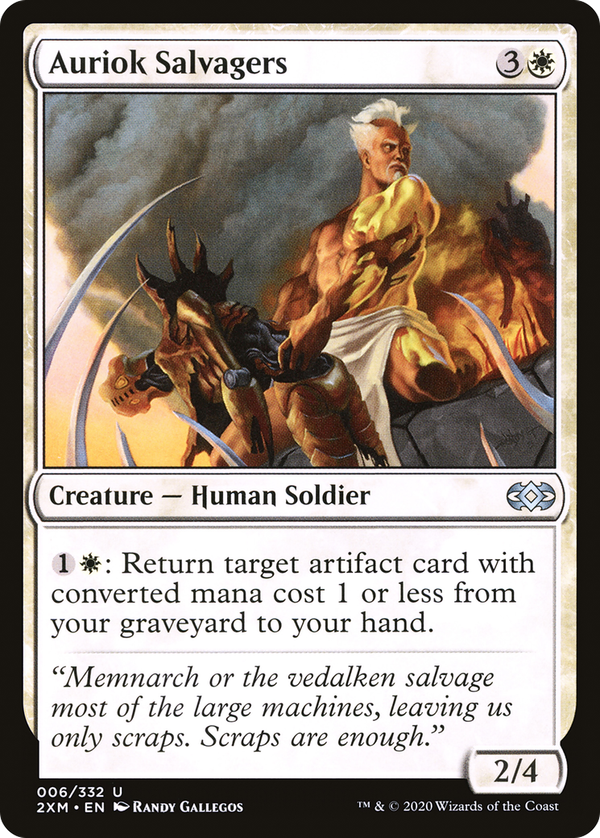
Rules text
 : Return target artifact card with mana value 1 or less from your graveyard to your hand.