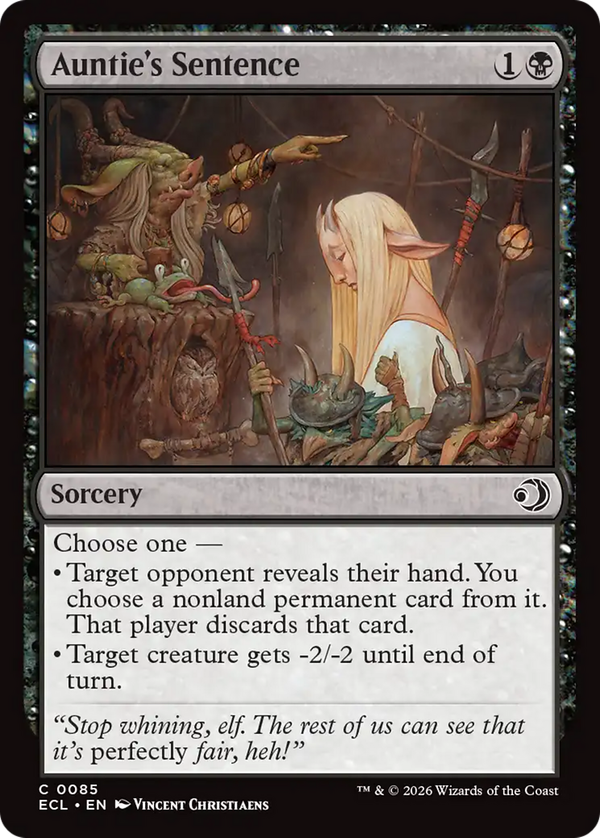
Auntie's Sentence


Two black staples usually live in two different slots: the hand-attack spell you want early, when your opponent's grip is full and choosing the right card matters, and the small removal spell you want later, when there's a body to answer and the topdeck war has begun. Splitting a role across the turn cycle is the design problem here, and the modal frame solves it by letting one card play both windows without diluting either. The discard half is targeted Coercion rather than random: revealing the hand and pulling a specific nonland permanent means you take the threat that actually matters, not whatever the coin flip surrenders. It cannot touch instants, sorceries, or lands, which is the restraint that keeps it from being a strict upgrade over blind hand disruption. The -2/-2 half is deliberately modest, a mode you reach for when the board, not the hand, is the problem: enough to clear early aggression or shrink a blocker, not enough to headline a removal suite. Neither mode is best-in-class in isolation, and that is the point. The value is in never holding a dead card: against a control deck you strip the threat; against a creature deck you point it at the biggest liability on the battlefield. Modal disruption of this shape has always been about smoothing variance, trading raw ceiling for the guarantee that the spell does something relevant whenever you cast it.