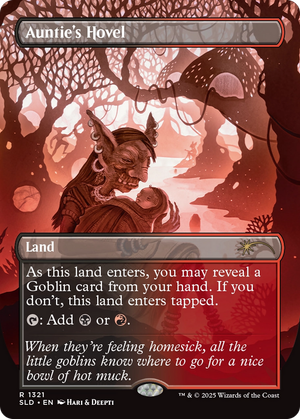
Auntie's Hovel
The conditional duals from this era solved a problem earlier tapland cycles never tried to: how to reward a committed tribal deck with untapped fixing without simply handing it to everyone. The deal is plain. Show a Goblin from your hand and the land arrives ready to use; whiff, and it comes in tapped like any guildgate. That reveal costs nothing but information, which is the elegant part of the design: a Goblin deck running on red and black almost always has a creature to flash, so the tap clause is a tax the intended deck rarely pays while the off-tribe deck pays it nearly every time. This is fixing gated by archetype rather than by life total or by a basic on the battlefield, and the gate is what licenses the rate. Each member of the cycle keyed off a different creature type, and the structure rewards exactly the deck the colors already point you toward: a tribe whose density of relevant cards is high enough that the conditional reads as "enters untapped" in practice. Outside a Goblin shell the reveal sits dead and the land is no better than a tapped dual, which is the cost of building a fixer this generous around a single creature type.
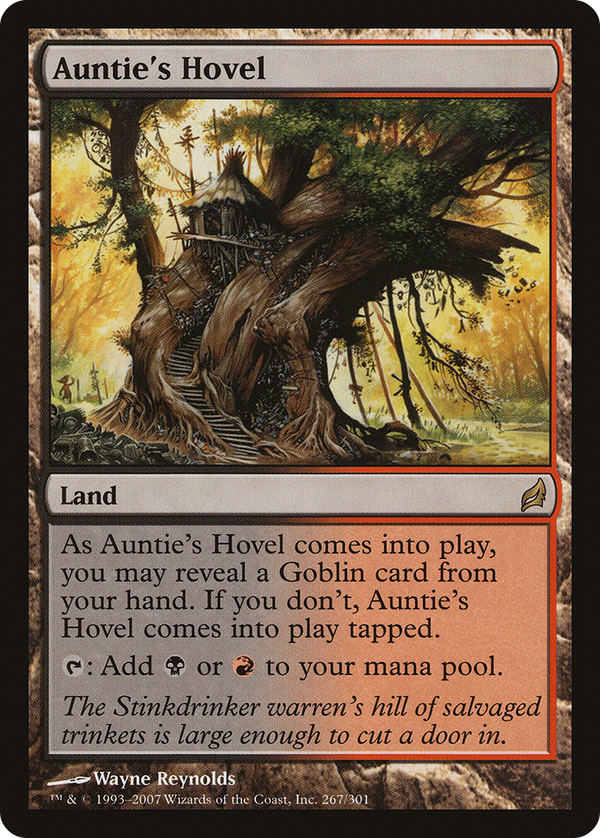
Rules text
 : Add
: Add  or
or  .
.