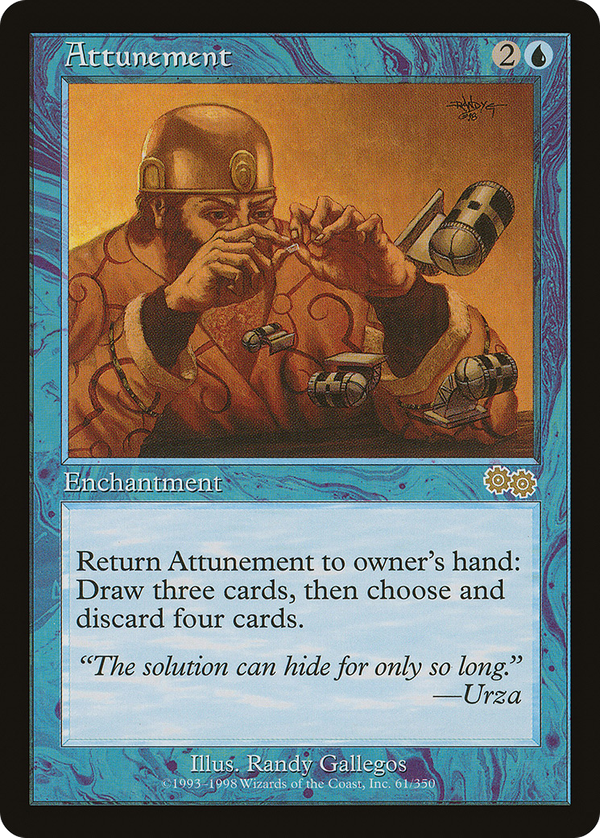
Attunement


The arithmetic is the whole pitch: drawing three and discarding four is a net loss of one card, and you can run it back every turn because the enchantment returns itself to hand each time. That looks like a downgrade until you stop counting cards and start counting destinations. The four discards aren't a cost here; they're the point. Anything that wants to be in the graveyard (reanimation targets, flashback fuel, threshold counters, dredge-style payoffs) gets there four at a time, repeatably, for the price of recasting a three-cost enchantment. The three draws keep the engine fed so the discards never run dry. This is filtering inverted: most loot effects sweeten the deal by drawing more than they pitch, trusting that hand size is what you want. Attunement assumes the opposite, that the yard is the real hand, and prices itself accordingly. The self-bounce is the elegant part of the design. It means the card never commits to the board, can't be killed in response to its activation, and resets to a clean reusable state every turn for three mana. That makes it a graveyard-filling faucet you can turn on and off at will instead of a single dump that fizzles after one use. Effects like this read as bad-stuff symmetry until you find the engine that flips the sign on every line of text, and then the worst-looking trade on the page becomes the cheapest way to fill a yard on repeat.