At Knifepoint



The clever trick here is that "commit a crime" is a triggered condition Rakdos was engineered to satisfy constantly: any spell or ability that targets an opponent, their permanents, or their graveyard sets it off, which means a removal-heavy black-red shell trips the token clause almost incidentally. That once-per-turn cap is what keeps the enchantment from spiraling: it turns the crime trigger into a metronome rather than a snowball, one Mercenary per turn regardless of how many opponents you carve up. The first-strike grant is the part that ties the two halves together. It only applies during your turn, so the enchantment is explicitly built for the swing rather than the block, and the Mercenary tokens it spits out feed their own +1/+0 pumps back into your attackers. The pump is sorcery-speed and taps the token, so it is a main-phase declaration, not a combat-trick ambush; you commit to the buff before attackers, then send a first-striking team that trades up. What makes the card cohere is that every piece answers the aggressive black-red gameplan from a different angle: the tribal lord effect rewards a wide outlaw board, the token generator rewards interaction, and the pump converts both into reach. It is a rare enchantment that asks you to play the deck it wants rather than just slotting into whatever exists, which is the tension a build-around lives or dies on.
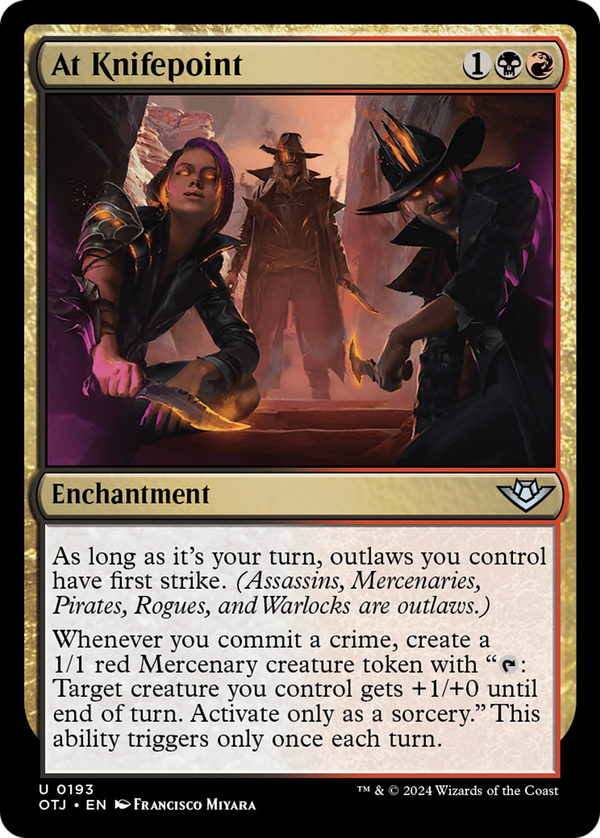
Rules text
 : Target creature you control gets +1/+0 until end of turn. Activate only as a sorcery." This ability triggers only once each turn.