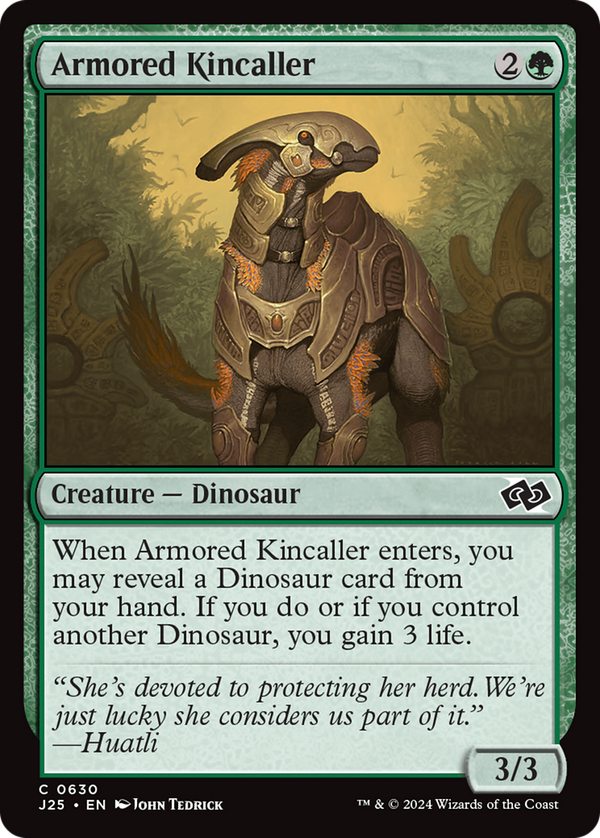
Armored Kincaller


The lifegain here is written to reward a board you were already trying to build. The reveal clause and the control clause are two keys to the same door: you can pay the information cost of showing a Dinosaur still in hand, or skip that entirely if you already control another Dinosaur. The design lesson is in how those two paths track a tribal deck's natural arc. Early, when your hand is full and your board is empty, the reveal keeps the trigger live; later, once you have committed creatures, the control clause makes the reveal a formality and the three life just arrives. It is a payoff that gets easier to satisfy exactly as the game goes long, which inverts most reveal-a-card designs, where the requirement grows more awkward as your hand thins. Strip the tribe out and the trigger simply fails to pay: the body remains a 3/3, the enters-the-battlefield ability still fires, but with no Dinosaur to reveal or control it resolves to nothing. That failure state is the point, not an oversight. The upside is fenced behind a creature-type commitment, so the card only rewards the deck it was built for, and nothing about it leaks value into a pile of unrelated green midrange creatures.