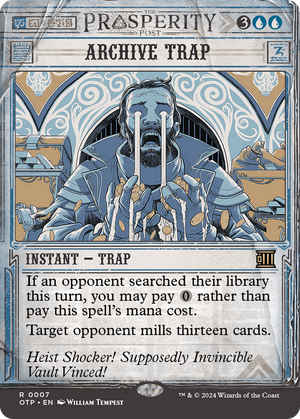
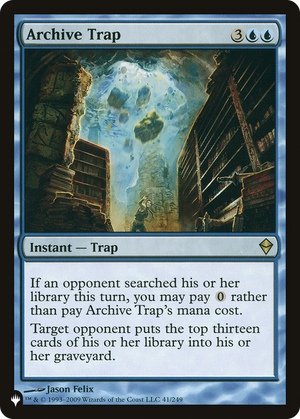
Archive Trap


The genius of the Trap mechanic was making a punishing effect free to cast at the exact moment the opponent earned it, and this is the most lopsided condition in the cycle. The condition is narrow but common: an opponent searching their own library, whether by cracking a fetchland, resolving a tutor, or fetching a basic in response to a land-destruction effect. Pay nothing, mill thirteen at instant speed. The number is not arbitrary; thirteen cards is roughly a quarter of a sixty-card deck dumped in a single flash, and in a mill shell the trap turns the opponent's own consistency engine into a liability. The opening they need to find their best cards is the opening you exploit to bury them.
What balances it is the conditional cost. Strip away the search condition and you are left with a five-mana instant that mills thirteen, a rate nobody pays on purpose. Crucially, it stays an instant either way: the alternative cost discounts it, it does not gate when you can cast it, so a hard-cast for full price remains legal if you ever need it. Still, the card lives or dies on whether the opponent volunteers the condition. Against a manabase that never cracks a fetch or runs a tutor, the alternative cost never comes online and the trap sits inert. Against a fetchland-heavy deck, it is a free haymaker the opponent arms for you. That swing, from dead card to backbreaking depending entirely on what sits across the table, is the whole design: power set not by what you do but by what your opponent cannot help doing.
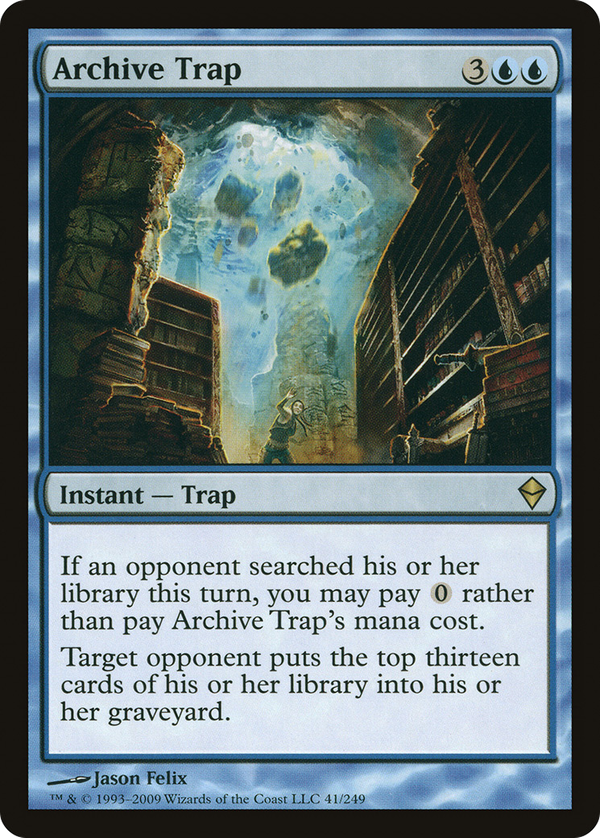
Rules text
 rather than pay this spell's mana cost.
Target opponent mills thirteen cards.
rather than pay this spell's mana cost.
Target opponent mills thirteen cards.