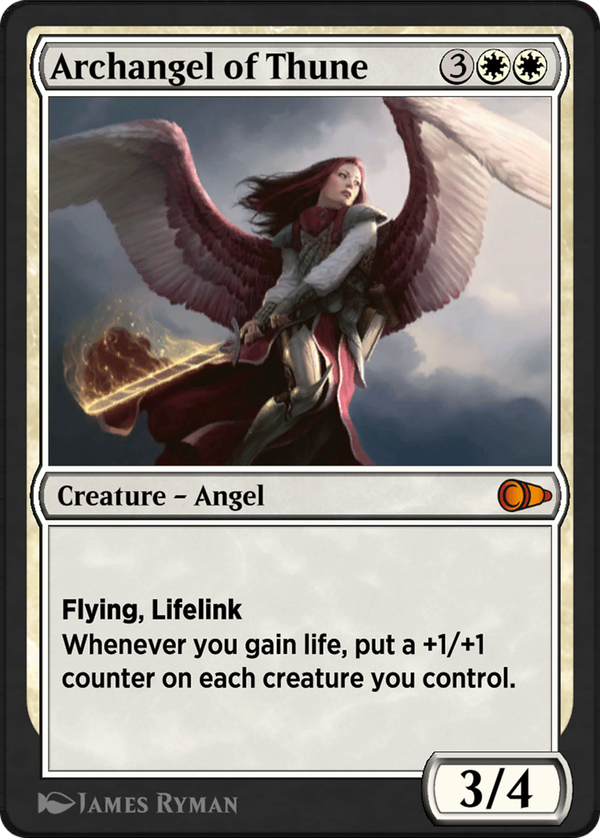
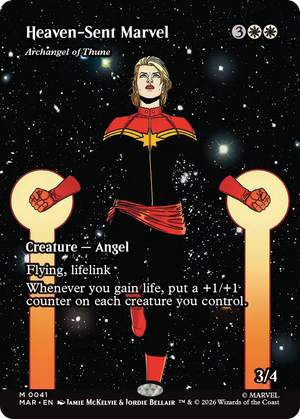
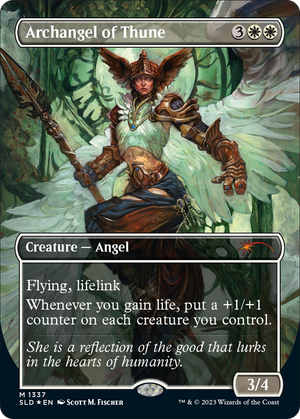
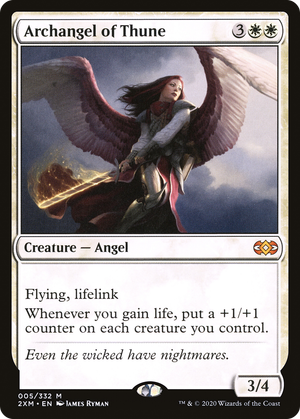
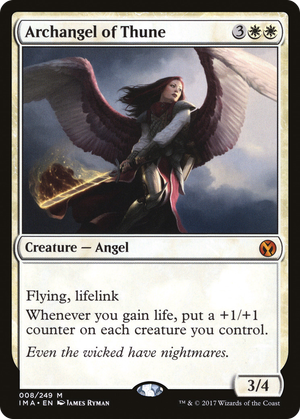
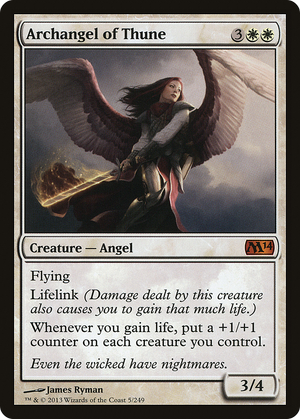
Archangel of Thune


The triggered ability here is the hinge, and it is built to feed itself. The static lifelink keeps the life total ticking up; the trigger that fires "whenever you gain life" answers each tick by parking a +1/+1 counter on every creature you control; the bigger board means the next attack drains for more; the larger drain gains more life and fires the trigger again. The loop compounds every turn the board survives. Crucially, the engine does not need this Angel to be the source of the lifegain: any incidental gain in the deck (a Soul Warden trigger, a single point off a drain effect, a lifelink creature already on the table) anchors a board-wide counter, which is why the card stops reading as a 3/4 flier almost immediately. The decision to gate the counters on lifegain rather than on combat is what makes the math exponential: every life source becomes a growth lever, and the loop closes the instant the Angel connects. The modest body is deliberate. It is the seed, not the payoff, so the engine has to earn its keep, and so an opponent who removes the Angel in response to the first counter trigger is still staring at a permanently enlarged team. Drop it alongside a wide board (a fistful of tokens, say) and one attack swings the game outright. Among white five-drops built around recursive value rather than a one-shot effect, this is the cleanest statement of lifegain as a counter engine, a template later lifegain-matters designs keep circling back to.