Arcane Spyglass

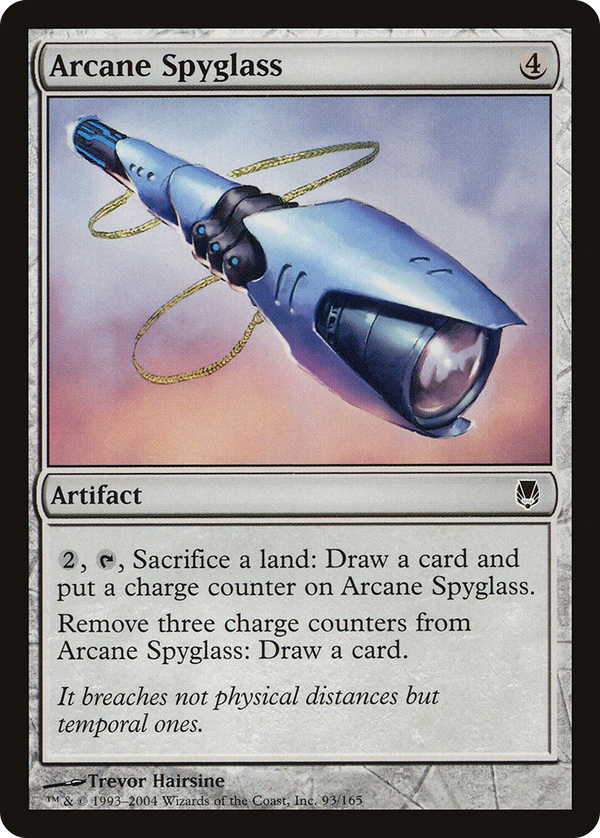
The trade here is land for cards, run through a counter ledger that makes the exchange slightly less brutal than it looks. Every activation eats a land and hands you one card, but it also banks a charge; three banked charges buy a fourth card with no land cost attached. So a card-draw engine built on a self-destructive resource (sacrificing your own mana base to draw) earns a little back over time, paying out one free card for every three lands fed in. The problem is the arithmetic never tilts in your favor fast enough. Four mana to deploy, then two mana and a tap each time you crack a land, means the engine is taxing your development to refill a hand you are simultaneously emptying of lands. The cost structure does leave one genuine upside on the table: timing. The ability carries no restriction, so you can dig in response to something or cash three counters at instant speed when a window opens. Cards that convert excess lands into cards have always wanted that conversion to be cheap and to pay off most when the board is flooded; this asks you to pay full retail while your battlefield shrinks. The charge-counter mechanic is doing real design work, deferring part of the payout to reward sustained use rather than one big turn. But the price was set before the game learned how generous land-to-card conversion could be, and the gap between what it asks and what it returns is why it never found a home.
Rules text
 ,
,  , Sacrifice a land: Draw a card and put a charge counter on this artifact.
Remove three charge counters from this artifact: Draw a card.
, Sacrifice a land: Draw a card and put a charge counter on this artifact.
Remove three charge counters from this artifact: Draw a card.