Arcane Investigator


A 2/1 for two that wants to be swinging early, paired with a card-drawing ability that costs six and asks the game to run long enough that swinging early never mattered. That deployment-and-payoff split is the whole design tension: the body lands in the opening turns, the engine wakes up in a phase the aggressive plan should have already ended. What the six buys is a repeatable card-advantage sink with a floor and a ceiling, and the twenty-sided roll decides which one you get. Miss the top band and you draw blind: one card, no choices. Hit it and you dig three deep, keep the best, and tuck the rest to the bottom. The difference between outcomes is not how many cards you get (always one) but how much you got to choose which one, the gap between a raw draw and an Impulse-style selection off the top three. That is the texture this era of d20 abilities added: an activation that is never dead but never certain, with variance skewed friendly (eleven of twenty faces land in the good half) while the price keeps it pushed far past the point a two-drop normally does anything. The result is a slow-game value engine stapled to a cheap creature, the two halves living in different phases of the game entirely, which is exactly why it reads as a value piece that never becomes a beater.
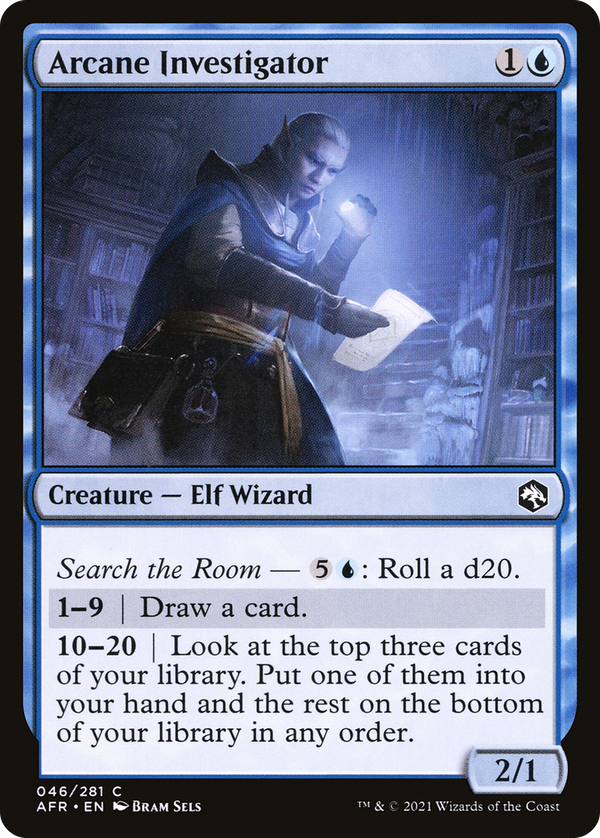
Rules text
 : Roll a d20.
1—9 | Draw a card.
10—20 | Look at the top three cards of your library. Put one of them into your hand and the rest on the bottom of your library in any order.
: Roll a d20.
1—9 | Draw a card.
10—20 | Look at the top three cards of your library. Put one of them into your hand and the rest on the bottom of your library in any order.