Apothecary White


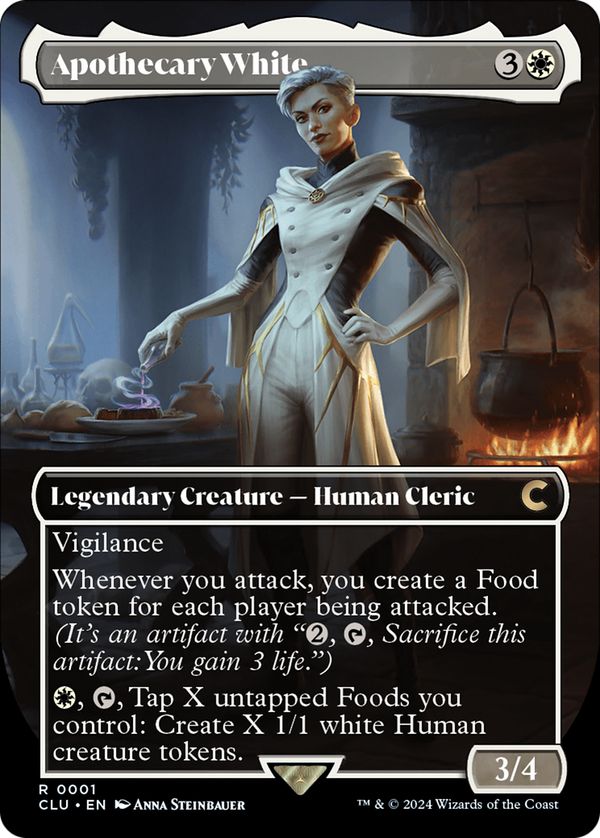
Food usually sits at the tail end of a design: a leftover token that buffers your life total three at a time, generated as an afterthought and cashed in only when there's nothing better to do. This turns that afterthought into a resource pipeline. The attack trigger mints a Food for each defending player, so the more directions you swing in, the faster the tokens pile up. Then the second ability rewrites what Food is for: instead of tapping and sacrificing them one at a time for life, you tap a batch of them (without sacrificing) to spit out an equal number of 1/1 Humans, converting stored life into a widening board. The tap-not-sacrifice wording is the wrinkle that separates this from a straightforward token converter: a given batch of Food can be tapped for Humans this turn and, on a later turn once it untaps, still be there to sacrifice for life if you switch modes. Vigilance keeps the trigger flowing turn after turn, since the attack that generates the Food never costs you a defender. What the design is really doing is inverting the resource's usual role. Life gain is a reactive, buy-time effect; here the same tokens that would have bought time get pointed forward instead, spooling out a body every time you decide you'd rather grow the board than pad your total. A payoff engine wearing the game's least threatening resource as a disguise.
Rules text
 ,
,  , Sacrifice this token: You gain 3 life.")
, , Tap X untapped Foods you control: Create X 1/1 white Human creature tokens.
, Sacrifice this token: You gain 3 life.")
, , Tap X untapped Foods you control: Create X 1/1 white Human creature tokens.