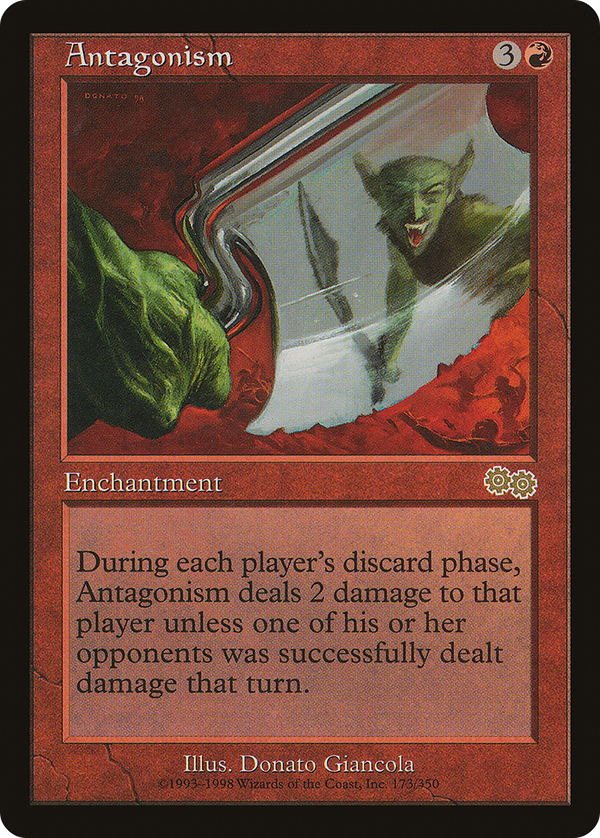
Antagonism


Punishment cards in red usually charge the table for inaction, but this one inverts the logic in a way the era rarely tried: it taxes peace itself. The trigger checks each player's end step for whether one of their opponents took damage that turn, and if nobody bled, that player burns for 2. The structural pressure falls on the defensive player, not the spell's controller; it converts a stalled board into a clock without asking the controller to commit anything beyond the initial four mana. The point is to make passivity expensive across the whole table at once, so the card does its most interesting work in a stalemate, exactly the game state red is otherwise worst at breaking. There is a price built into that, though: the threat is symmetrical. The controller is also a player with an end step, also obligated to have damaged an opponent, and a deck running this that fails to deal damage to an opponent is signing up to take its own 2 every turn. That self-applied burn is what holds the card in check, and it dictates what kind of deck wants it: not control, but something that always has a body swinging anyway and is happy to staple a global incentive onto its own aggression. A genuinely odd political artifact from a period when multiplayer was not a design priority, it reads now like an early sketch of the punisher-enchantment space that later cards would build out more cleanly.