Anointer Priest


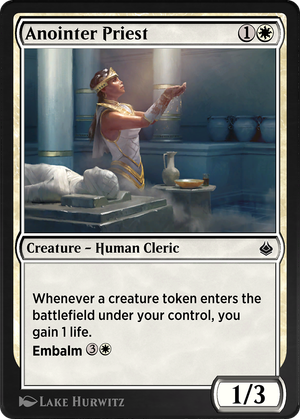
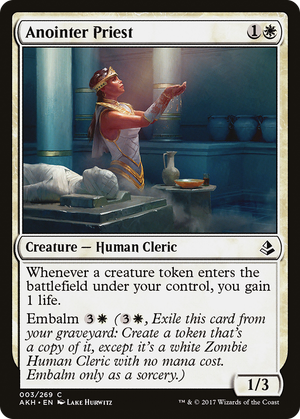
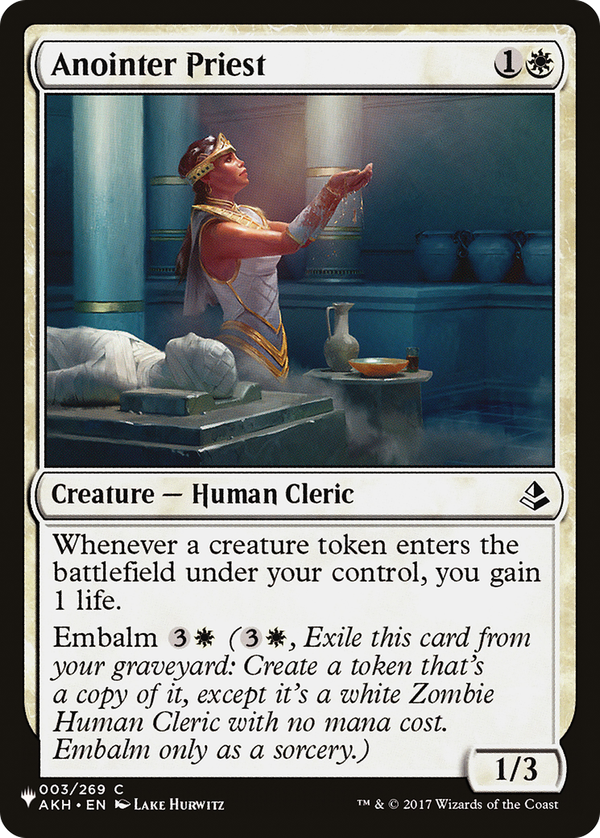
The trigger is narrower than the lifegain payoffs that came before it: not "whenever a creature enters," not "whenever a creature dies," but specifically a creature token you control entering. That restriction is what makes the rest of the design coherent. A 1/3 body parks behind a token-generating engine and turns each Servo, Saproling, or Soldier into a steady drip of life, the kind of incremental gain that matters far more in aggregate than any single point suggests. Embalm closes the loop in a way that borders on self-referential: the Priest exiles itself from the graveyard to make a token copy, and that copy is itself a token entering, so the recursion you pay  for also hands you a point of life on the way back. The cleverness is in how cleanly the two mechanics interlock. Embalm was built to give creatures one second body without the open-ended repeatability of true graveyard recursion, and bolting that onto a token-counting trigger means the Priest's own resurrection registers as a trigger of the very thing it does. Most token-payoff designs ask you to commit to a dedicated go-wide shell before they pay out anything; this one asks for the same, but quietly rewards you when the engine pieces themselves die and come back, which is exactly the kind of attrition a grindy white deck wants to win on.
Rules text
(, Exile this card from your graveyard: Create a token that's a copy of it, except it's a white Zombie Human Cleric with no mana cost. Embalm only as a sorcery.)