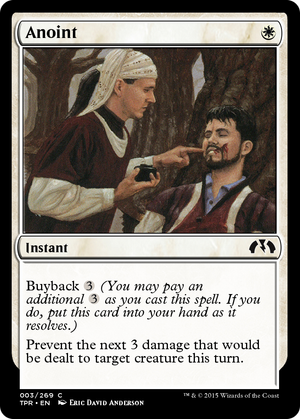
Anoint

Damage prevention on a single creature is the kind of marginal combat trick that rarely justifies a card even once, and bolting an engine onto it exposes the seam in the buyback experiment. The keyword's premise was that paying an extra cost to return a spell to your hand turns a one-shot into a recurring fixture, and it shone on effects that compound: a counterspell you cast every turn, a bounce that resets the board, a Capsize loop that grinds an opponent out. Prevention does not compound. It delays. Spend four mana total here and you keep one creature alive through one combat step before recouping the card, a worse rate than simply holding a real removal spell or a trick that swings combat outright. The mismatch is the whole story. Buyback multiplies relevance; it cannot manufacture it, and there was very little base effect here to multiply. The underlying spell was thin, the payload was something nobody wanted to fire once, and the three-mana buyback tax attached an engine to it anyway. What survives is a useful illustration of the design discipline behind the mechanic: buyback rewards spells whose effects accrue value across repetitions, and pins a heavy premium on the front of every cast to keep that loop honest. Attach that structure to the wrong effect and you get this, an engine wrapped around a payload that was never worth running.
Rules text
 (You may pay an additional as you cast this spell. If you do, put this card into your hand as it resolves.)
Prevent the next 3 damage that would be dealt to target creature this turn.
(You may pay an additional as you cast this spell. If you do, put this card into your hand as it resolves.)
Prevent the next 3 damage that would be dealt to target creature this turn.