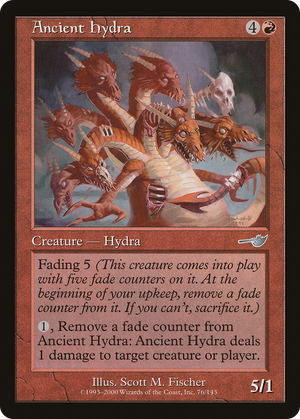
Ancient Hydra


Fading is the rare mechanic that doubles as a built-in resource meter, and this is the cleanest expression of how Nemesis-era design used it. The five fade counters aren't just a death clock; they're ammunition. Every counter you spend pinging a target for one damage is a counter you're not removing at upkeep, which means the card asks a constant question: do I hold the body together, or do I cash it in? The 5/1 frame sharpens the bargain. A glass-cannon attacker that the slightest blocker trades into, so the counters are usually worth more burned as removal than spent keeping a fragile creature alive on the battlefield. That tension is the whole card. You're not building toward a stable engine; you're metering a finite pool of damage and deciding, turn by turn, whether the next point goes to the face, to a creature, or to buying one more turn of existence before the sacrifice clause catches up. The design discipline is that the fade counter is the same currency for survival and for output, so the card can never do both at full capacity. It's a small, self-contained study in how a single counter pool can govern an entire creature's lifespan and its value at once, which is exactly the kind of friction fading was invented to model.
Rules text
 , Remove a fade counter from this creature: It deals 1 damage to any target.