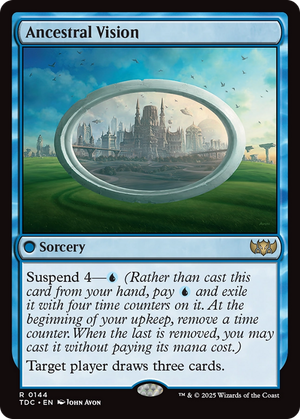
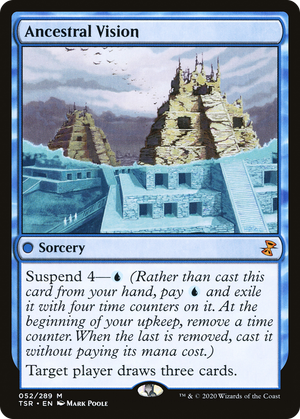
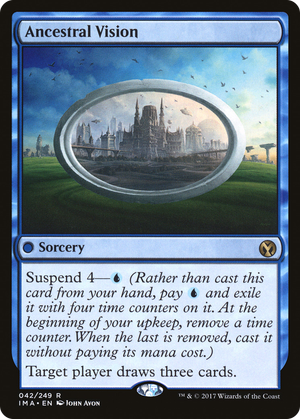
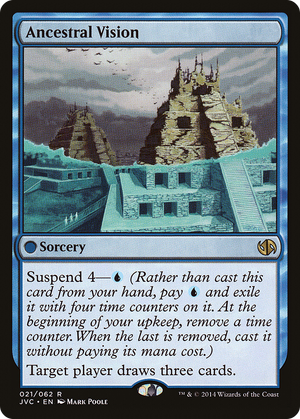
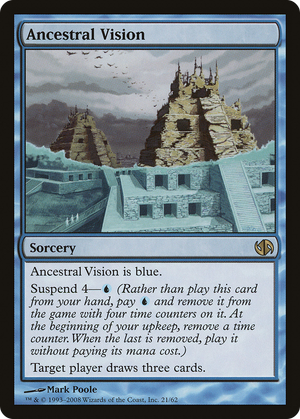
Ancestral Vision
The whole proposition is a trade of time for mana. Pay one blue, wait four upkeeps, and three cards arrive for free at the end: a draw spell whose entire price is patience. It is the cleanest illustration of why suspend was such a sharp mechanic. With no practical front-face cast cost, the card almost always enters via the suspend clause, which means the deck commits to it on turn one and gets paid back four turns later. That delay is the balancing weight. A three-card draw at instant speed would warp any format it touched; a three-card draw that announces itself four turns in advance, cannot be cracked early, and yields nothing in the window where you actually spend the mana, is a control deck's opening gambit rather than a midgame lifeline. It pays off the deck that survives long enough to collect, and it punishes that same deck when the game ends before the counters run out. The design problem here is how to print raw card advantage at a rate that would otherwise be illegal: the mana is trivial, so the cost is paid in the most expensive currency a control deck has, which is the early turns it would rather spend interacting. Few cards make the idea of time-as-resource so legible on a single line of text.
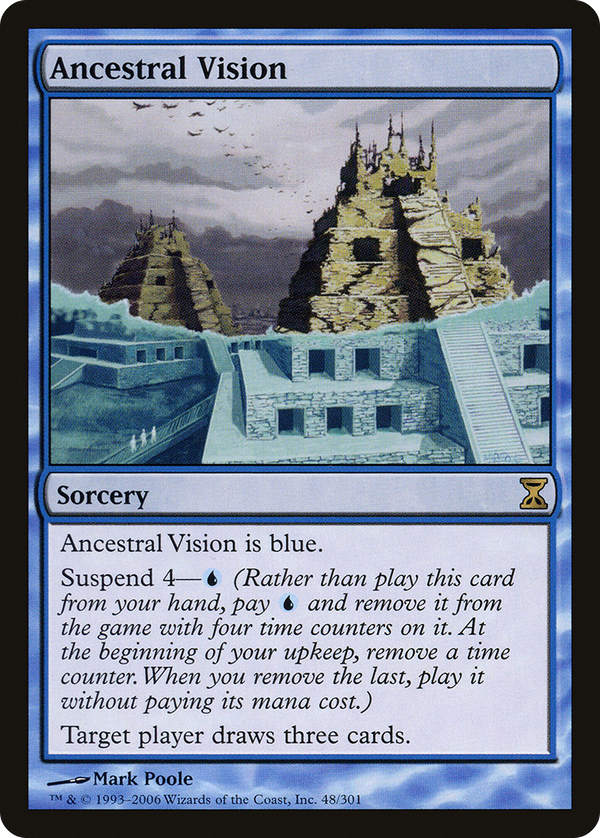
Rules text
 (Rather than cast this card from your hand, pay and exile it with four time counters on it. At the beginning of your upkeep, remove a time counter. When the last is removed, you may cast it without paying its mana cost.)
Target player draws three cards.
(Rather than cast this card from your hand, pay and exile it with four time counters on it. At the beginning of your upkeep, remove a time counter. When the last is removed, you may cast it without paying its mana cost.)
Target player draws three cards.