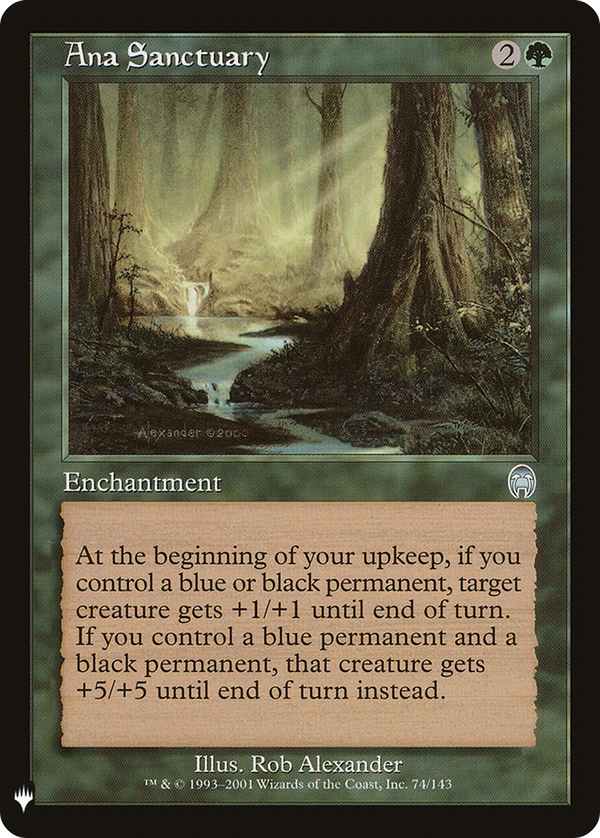
Ana Sanctuary


The gradient is the whole point. Control any blue or black permanent and you nudge a creature by a token point; control one of each and that nudge becomes a recurring +5/+5 finisher every upkeep. The floor exists only to make the ceiling feel earned, and the ceiling lives entirely in a three-color commitment to what would later get called Sultai. What makes the condition narrower than the colors suggest is that it checks permanents, not the colors of your spells: a colorless mana rock that taps for blue or black does not feed the bonus, because it is not itself a blue or black permanent. The trigger wants actual on-color cards on the battlefield: a creature, an enchantment, a planeswalker that happens to be blue or black. That reframes the card as a deckbuilding tax run backward. Most multicolor designs of this kind punish you for missing the right lands; this one offers only a token buff until your board proves it can field permanents in two off-colors, then rewards the stretch with a buff that ends games. The trouble is that nobody ever wanted both halves of the bargain at once: the buff is slow and the splash is steep, and a deck willing to pay the second rarely needed the first. As an artifact of the era when designers were deliberately teaching formats to break their own color rules, the escalating clause is a clean specimen. It never found its home, but the logic behind it (reward the riskier board, not the safer one) reads as intentional rather than accidental.