Amareth, the Lustrous




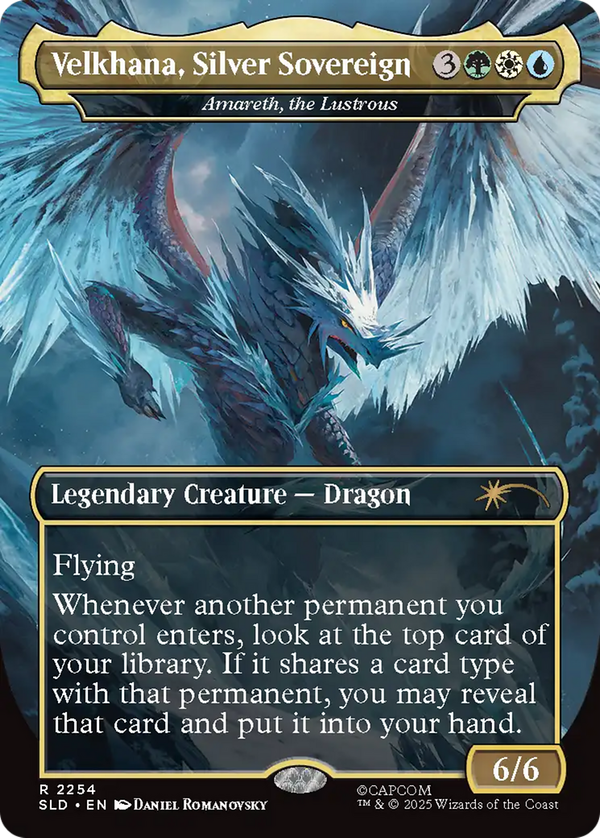
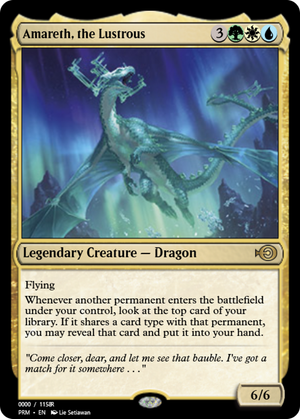
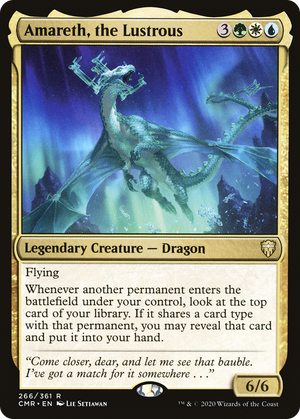
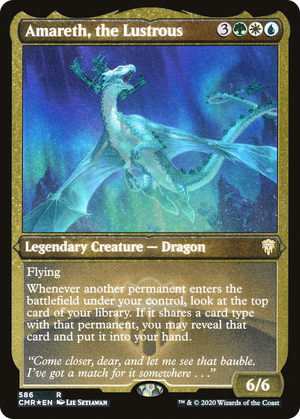
The card-type-matters payoff is a strange, quiet corner of design, and this is the Dragon built entirely around it. Every other permanent that enters under your control fires a small lottery: a token spat out by an anthem, a creature flickered back into play, an artifact you hard-cast, all of them check identically. The trigger peeks at your next card and pays out only if it shares a type with the permanent that just entered. Nothing about the rest of your board matters; the check is strictly the entering permanent against one card. That single-comparison structure inverts the deckbuilding instinct you might expect from a Bant commander with three colors of value at its disposal. Because the entering type and the revealed type both have to line up, a deck concentrated on one type (an enchantment-heavy shell where nearly everything you play and nearly everything you draw is an enchantment) hits far more reliably than a scattered toolbox, where each entrance checks against a library full of mismatched types. Concentration, not diversity, feeds this engine. The look-then-reveal-only-if-they-match structure keeps it throttled: it is an information glimpse that converts to a card only when the types agree, so the payout is governed entirely by how tightly your library's type distribution matches whatever you tend to be putting into play. The 6/6 flier is a serviceable frame to hang all of that on, but the draw is the trigger, and the counterintuitive puzzle of building narrow rather than wide to keep it firing.