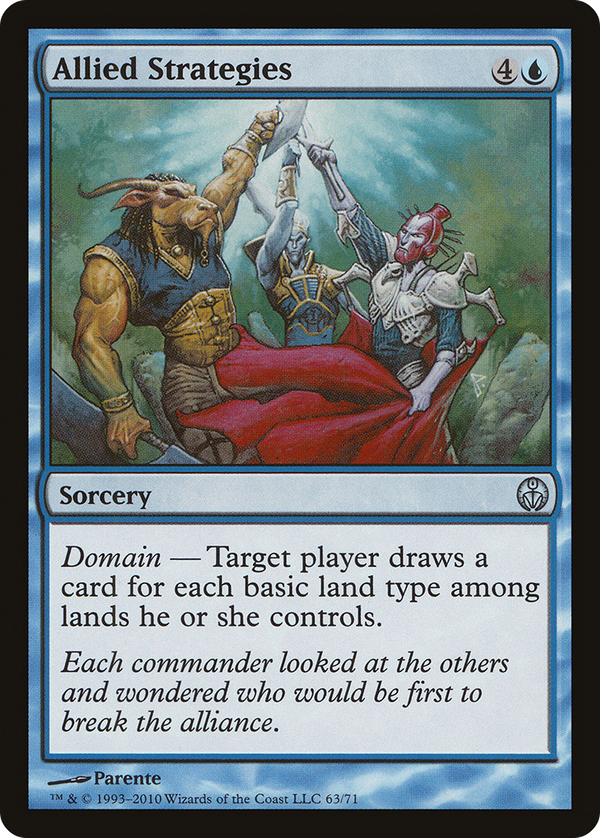
Allied Strategies


Five mana, always five mana: domain never touches the cost, only the payoff. At a single basic land type this is a strictly worse cantrip, a draw-one you overpaid for; at full domain it is a five-mana draw-five that any blue control shell would happily run. The bargain is paid entirely in deckbuilding. You buy the ceiling with land slots, committing to a manabase that runs one of every basic land type before the card pays you back, and the rate is dismal until you have done that work. This is the early five-color design language at its most literal: an effect that does nothing remarkable on its own terms but rewards the player who has already warped a manabase toward the rainbow, with dual lands and fetchable basics doing the heavy lifting.
The clause that complicates it is the target. The draw counts basic land types among the chosen player's lands, not the caster's, so the card has two distinct uses that share no logic. Pointed at yourself, it is a control engine that demands you build the wide manabase. Pointed at someone else, it becomes a political instrument, and the count is theirs alone: your own greedy lands are irrelevant, so it only pays if the recipient has assembled the spread. The targeting reads like flexibility, but in practice it splits the card into a selfish draw spell and a gift you cannot meaningfully aim except at a table partner already spanning all five basic land types.