Allay


Exodus built its enchantment-removal pivot around a question of repeatability: how do you give a deck access to recurring answers without forcing it to draw multiple copies? Buyback is the answer, and it reframes what a removal spell is. The base mode is unremarkable, the kind of utility effect that has existed in white since the game began. Pay the buyback cost and the spell stops being a card and becomes a service: five mana to destroy one enchantment and return the spell to your hand, ready to do it again next turn. The tension is that you only want the buyback half against an opponent leaning on enchantments, so the choice lives in the moment of casting rather than at deckbuilding, where you read the matchup before committing the extra mana. Instant speed compounds the value, letting the recurring effect answer an enchantment the turn it resolves rather than waiting for your own main phase. Allay belongs to a cycle of buyback removal spells from the same set, each pointed at a different permanent type, and it represents an early, honest attempt at the design problem that flashback, retrace, and rebound would later approach from other angles: how to let a single card act more than once without making it free. The buyback tax keeps the loop fair; every reuse pays full freight, so its value scales with a board state where enchantments keep arriving rather than a single removal need.
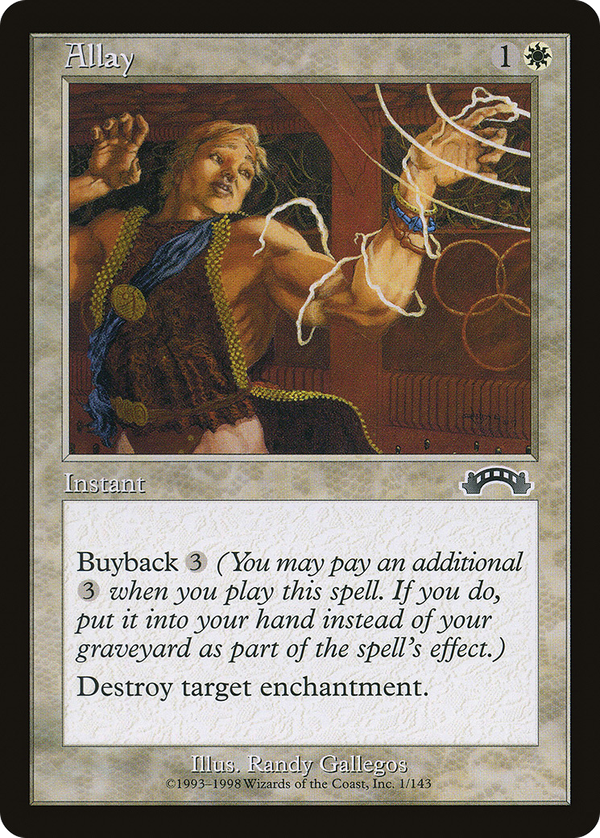
Rules text
 (You may pay an additional as you cast this spell. If you do, put this card into your hand as it resolves.)
Destroy target enchantment.
(You may pay an additional as you cast this spell. If you do, put this card into your hand as it resolves.)
Destroy target enchantment.