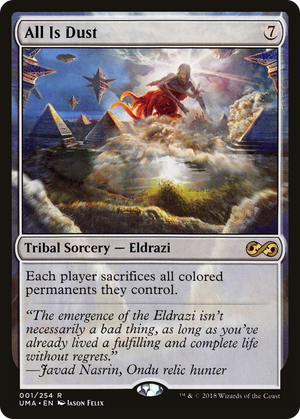
All Is Dust

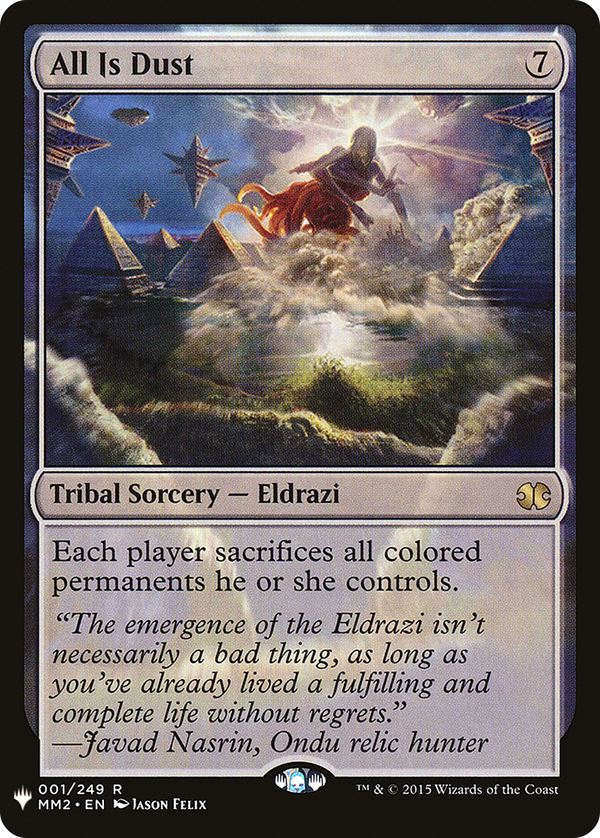
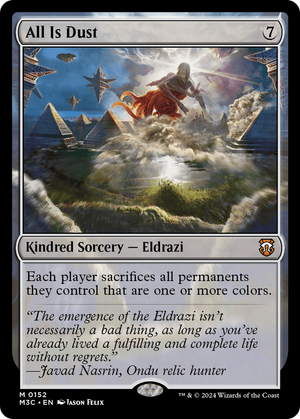
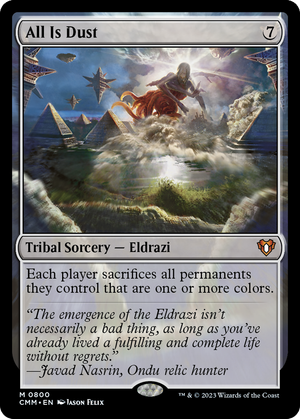
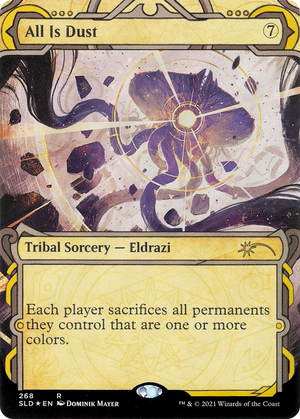
The colorless clause is the whole trick. Where most board wipes ask "creature or not," this one asks "colored or not," and the difference rewrites which side of the table eats the loss. A deck built on colorless permanents (Eldrazi, mana rocks, manlands, devotion-free artifacts) walks away clean while the opponent's colored battlefield evaporates: not just creatures, but enchantments, planeswalkers, and the colored permanents most decks lean on for fixing and engines. That asymmetry is what separates this from a symmetric Wrath of God effect; it is a sweeper you can aim by deckbuilding rather than by timing. The cost reflects it. Seven generic mana is steep for a sorcery, but the price buys a reset that catches permanent types other wipes ignore and leaves your own colorless shell standing. It also folds neatly into the colorless ramp it shares a strategy with: the same Eldrazi-adjacent decks that produce eight-plus mana on schedule are the ones positioned to play it as a one-sided clear and keep developing. The design lesson it taught is durable: build a sweeper around a permanent's color rather than its card type, and you create a board wipe that punishes the broad middle of the metagame while sparing a narrow, intentional list. Sacrifice is the delivery mechanism, which matters for what it bypasses: indestructible, regeneration, and protection from a color all fail to save a permanent forced to the graveyard by its controller.