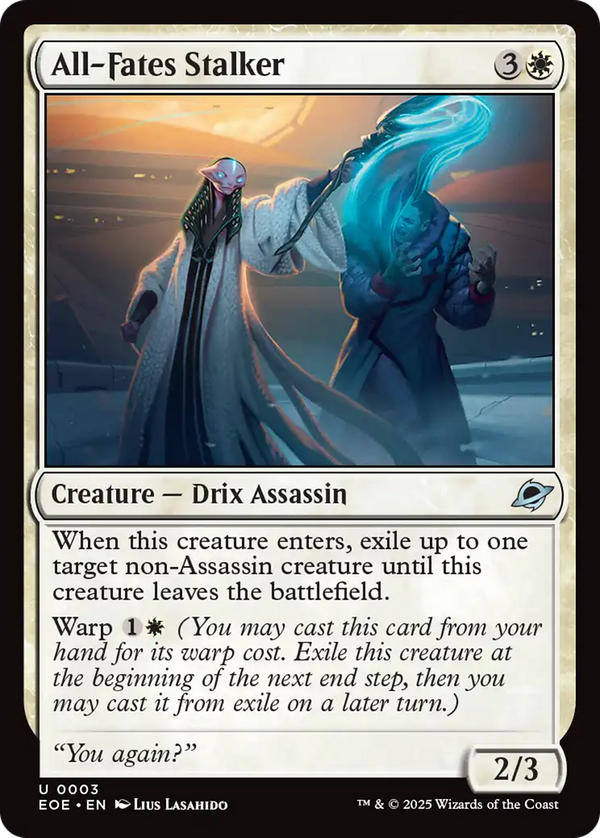
All-Fates Stalker


Flicker-removal has always been white's tidiest lie: the Banisher Priest and Fiend Hunter line answers a creature only for as long as the answer stays put, and killing the jailer frees the prisoner. Warp turns that vulnerability into a scheduling tool. Paid for its warp cost, the body enters, exiles a threat, then leaves at the beginning of the next end step and hands the prisoner back: a one-turn removal spell that plans its own escape. The exiled creature returns, but the tempo swing has already landed, and the card itself is not spent. It sits in exile, available to be cast from there on a later turn, this time as a permanent 2/3 with the same exile-on-entry stapled on. So one card does two jobs on two clocks: an early sorcery-speed tempo play that pulls a blocker or an attacker off the board for a turn, then a durable second casting that answers something for keeps. The non-Assassin clause on the exile is the honest restriction, keeping it from cleanly policing its own tribe, but the real design tension is timing. Because warp only casts at sorcery speed, you are not choosing when in a turn to strike; you are choosing whether to spend this as a flicker-tempo trick now or bank it as removal-with-a-body later. Warp lets you defer that choice until the board tells you which one you need.
Rules text
 (You may cast this card from your hand for its warp cost. Exile this creature at the beginning of the next end step, then you may cast it from exile on a later turn.)