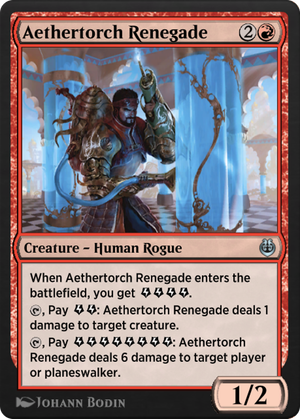
Aethertorch Renegade


The fork is the whole design: on entry the controller banks four energy, then chooses which clock to feed. The cheap mode (tap and spend two energy to ping a creature) is a repeatable pest-killer that converts the reserve into a slow trickle of removal, while the expensive mode (tap and dump eight) reaches over the board to throw six at a player or planeswalker. What makes the math sing is that both modes draw from the same pool, so every two energy spent on early creature attrition is two energy not banked toward the burst. Four counters is enough to fire the small ability twice, or to sit halfway toward a single big swing. From there it is a tug-of-war between defense now and reach later, and the two payoffs are explicitly at odds. Energy as a design currency was always about deferred payoff: you accrue a resource that does nothing until you decide what to convert it into, and this is one of the cleaner expressions of that tension, because the conversion options compete for the same counters rather than stacking. The 1/2 frame is deliberately fragile; this is a value engine that wants to survive on the strength of its first ability, grind the board into stillness, then close once the table has stopped pointing attackers at it.
Rules text
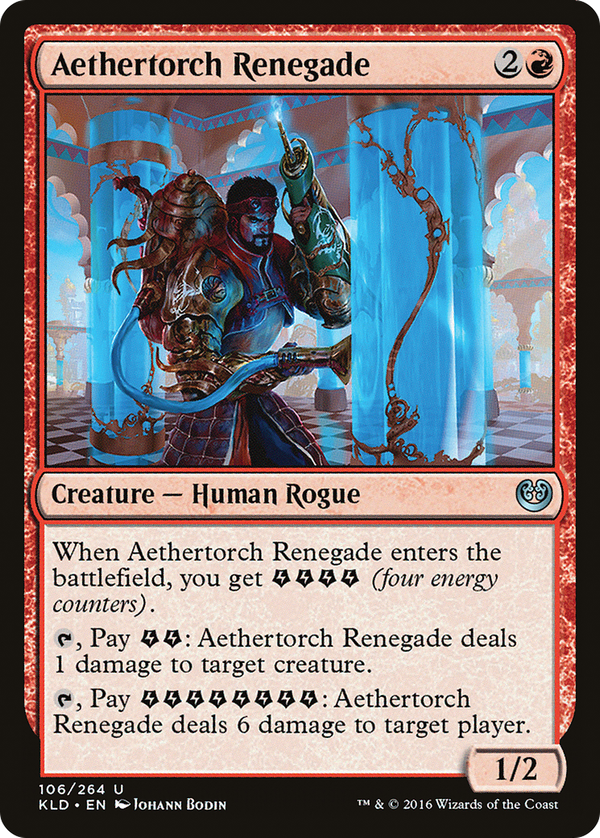
 (four energy counters).
 , Pay : This creature deals 1 damage to target creature.
, Pay eight : This creature deals 6 damage to target player or planeswalker.
, Pay : This creature deals 1 damage to target creature.
, Pay eight : This creature deals 6 damage to target player or planeswalker.