Aerial Caravan


Impulse draw arrived decades early, stapled to a six-mana flier. The activation banishes your next undrawn card and lets you play it only this turn, the same exile-and-burn template blue and red would later turn into a recurring keyword's worth of design space, but the early version is sharper-edged than its descendants. Pay three mana and you peek at a card you cannot bank, cannot hold, cannot sandbag for a future turn; it is card advantage that rots the moment the turn ends. That decay reframes what the ability is good for. It is a mana sink for a player already ahead, not a refueling engine for one falling behind, because spending three mana on a maybe-card is a luxury only an open board affords. The flier earns its keep here: a 4/3 with evasion gives you a slow clock to grind out while you dump spare mana into the activation every turn, converting a long game into a relentless one. What the ability never does is dig. You see exactly what comes off the deck next, no scry, no selection, so each activation gambles on whatever order your library shuffled into. That gap between drawing a card and exiling one you might not even get to cast is the friction that kept this kind of effect from being a strict upgrade on a real draw spell, long before the mechanic had a name.
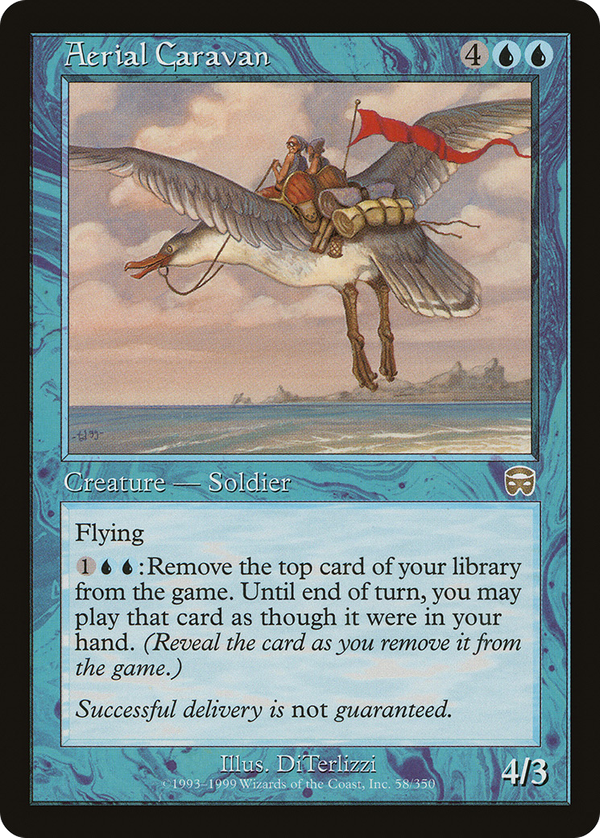
Rules text
 : Exile the top card of your library. Until end of turn, you may play that card. (Reveal the card as you exile it.)