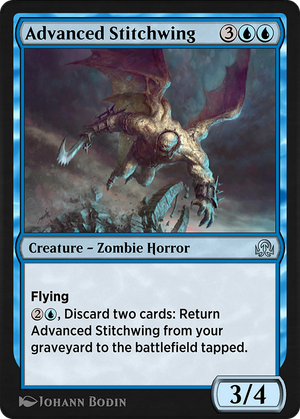
Advanced Stitchwing


The recursion clause is the entire pitch, and it is priced in cards rather than mana. A 3/4 flyer for five is a fair body and nothing more; what gives the card legs is that it never stays dead, climbing back from the graveyard for  plus the discard of two cards. That cost is the lever the design pulls: the mana is cheap so the card-disadvantage can stay steep, which keeps a recurring evasive threat from snowballing out of control. The discard is the point rather than a tax. It feeds graveyard-matters strategies, fuels madness payoffs, and turns the flyer into a delivery system for whatever you actually wanted in the bin. The activation carries no timing restriction, so the return can happen at instant speed: crack it on an opponent's end step and the body untaps for your turn, or bring it back in response to graveyard hate before the bin gets exiled. What the tapped clause takes away is the surprise block or ambush attack, not the flexibility of when to pay. That distinction is the shape of the piece: it is an attrition engine for the long game, a reusable clock that asks you to keep two cards on hand worth throwing away, and rewards a deck constructed so that throwing them away is upside instead of cost.
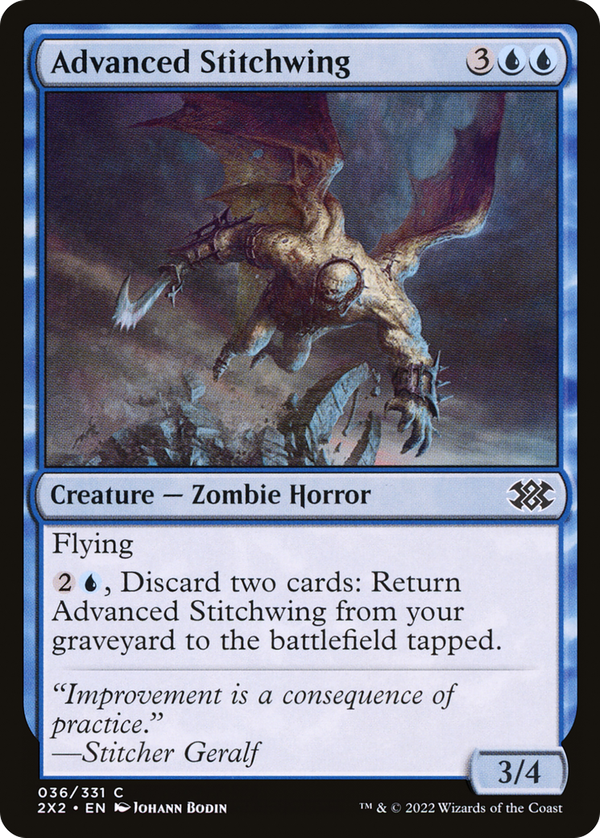
Rules text
, Discard two cards: Return this card from your graveyard to the battlefield tapped.