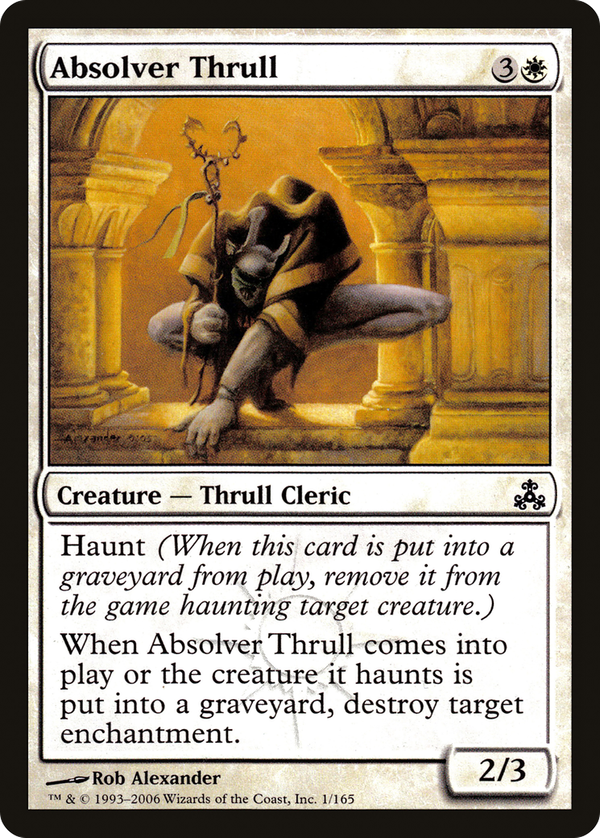
Absolver Thrull


Enchantment removal stapled to a body was no novelty, but Haunt let this one fire its destroy effect twice across two points in time from a single card. The first trigger resolves the moment the Thrull enters. The second sits dormant: when the creature dies, it exiles to haunt a single target creature, and only when that haunted creature later dies does the second destroy fire. That is exactly one delayed answer, not a renewable one. The design trades immediacy for patience. You commit the card now, choose what to haunt, and wait for a death you may or may not control: combat, a sacrifice outlet, a removal spell you cast yourself. The cost is steep when the board offers nothing to point at. Against a deck running no enchantments, both halves are dead weight bolted to a 2/3, and the haunt half is doubly hostage, because it needs a legal enchantment target at the precise moment the haunted creature dies, a window you cannot always engineer. This was the era's experiment in deferred value: spreading one card's effect over a now and a later, asking the player to bank a trigger rather than hold up mana for it. The Cleric is among the cleaner expressions of the idea, but the narrowness cuts deep. Where a flexible answer covers artifacts and enchantments both, this only ever destroys an enchantment, which makes its second life entirely dependent on what the opponent has chosen to commit.