Abandoned Sarcophagus

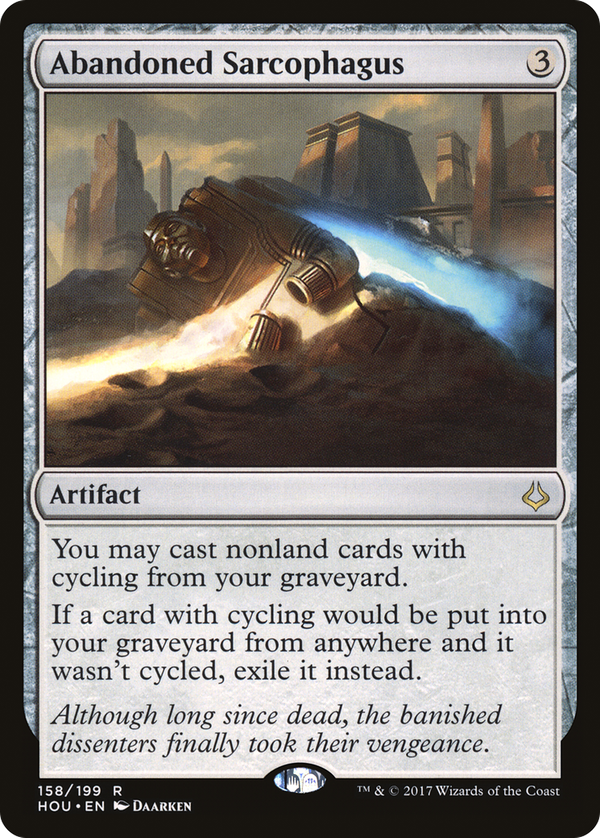
Cycling carries a quiet inefficiency: when you pay the cycling cost, you draw a card and the spell itself goes to the graveyard fully spent. This artifact reclaims that wasted half, but only for cards it actually cares about: spells with a cycling ability become castable from the graveyard, so a cycled removal spell or creature gets a second life while cycling lands and other nonspell cyclers stay dead. The exile clause is the price of the engine. Any card with cycling that hits your graveyard without being cycled gets banished instead, so you cannot mill, discard, or sacrifice your way into the rebuy; you have to spend the cycling cost to earn the second cast. That keeps the loop honest as deferred card advantage rather than open-ended recursion. The structural irony is sharp: an artifact built to recover spent cyclers actively punishes every other way those same cards might reach the graveyard, which is exactly what separates it from generic reanimation or flashback-style value. It is a closed loop that opens for one action and slams shut for all others. As an enabler it belongs to a narrow lineage of cards trying to turn cycling from pure velocity into a value axis, and it demands real commitment: the cycling package has to be dense enough that the second-cast plan is the deck's spine, not a footnote to the smoothing it already provides.