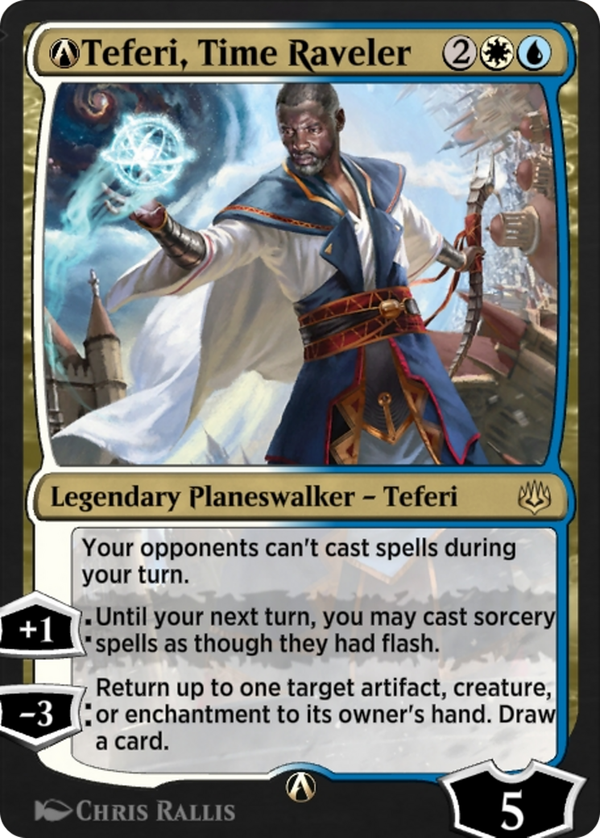
A-Teferi, Time Raveler



The static ability is the whole quarrel. Locking opponents out of the stack on your own turn does structural damage to how interactive Magic is supposed to work: no counterspells while you resolve your combo, no instant-speed removal while you assemble your board, no flash blocker on your alpha strike. Control decks lost the ability to answer a resolving threat during the controller's turn, and combo decks lost their fear of being interrupted mid-loop. The minus mode compounds the frustration, bouncing an artifact, creature, or enchantment (not lands, not planeswalkers) and replacing itself with a card, so even when the static tax is not the point you rarely draw a blank. That combination (a hard axiom against opposing interaction, stapled to a self-replacing tempo swing) is why the original printing drew a competitive ban rather than a slow fade from relevance. The plus mode letting you cast sorceries as though they had flash rounds out a design built to invert the usual permission structure: you get the flexibility your opponent is denied. What makes this a genuinely thorny piece of design is that it does not need to attack a life total or protect a wincon to warp a game; it changes the rules of engagement the moment it lands, and asymmetrically. Every deck that leaned on reactive answers had to reckon with a permanent that simply turned reaction off.